
Transformation Zones: Beyond Business as Usual
A Transformation Zone…
- Is a collaborative approach to implementing, scaling, and sustaining systems change
- Starts with one “slice” of a complex system in a defined area that is small enough to manage, yet large enough to represent all levels of the system
- Engages representatives from each level to regularly meet and work together toward desired changes
- Provides dedicated space and time for teams to identify issues, design and test solutions, make collective decisions, and build infrastructure to expand and sustain change
- Helps implementation efforts move beyond business as usual to imagine and realize an ideal system
When innovations do not produce their desired outcomes, is it because of the innovation itself or because of the context that surrounds them?
Having effective innovations and effective implementation practices are only two of the three critical elements in the formula for successful implementation. Agencies invest time, money, and resources into choosing evidence-based practices (EBPs), training their staff, and launching them, but often still experience inconsistent or unsustainable outcomes. The third element of successful implementation involves enabling contexts—the structures, policies, and conditions of a broader system that work together to create favorable conditions for innovations to flourish.
Figure: Active Implementation Success Formula

When these structures, policies, and system conditions present barriers to implementation, addressing them can feel overwhelming, and knowing where to start may feel impossible. Transformation Zones offer a way to address this. In a transformation zone, effective practices are tested, refined, and improved, while multiple linked implementation teams simultaneously develop and strengthen the systemwide infrastructure needed to support them.
What are Transformation Zones?
“It is impossible to make significant change simultaneously and successfully in all parts of a system… The transformation zone allows capacity to be developed and transformative changes to be made while limiting unintended negative outcomes” (Fixsen, Blase, & Van Dyke, 2012).
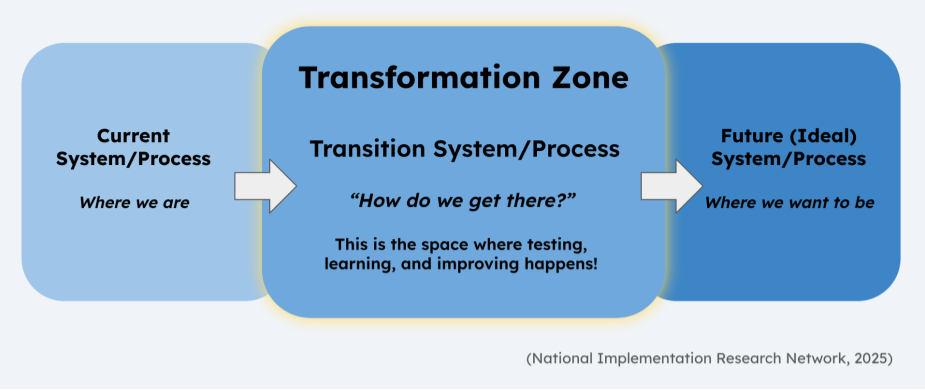
A transformation zone is a highly collaborative approach to improving and reshaping systems. They bring together representatives from all levels of a system, including those at the levels of decision-making authority and governance, delivery, and delivery support, and those receiving the program. Together they test, learn, and build new ways of working that improve the system so that effective practices can be better implemented, scaled, and sustained.
From the practice to policy level, transformation zones intentionally operate within a vertical “slice” of a system that is large enough to discover the challenges that come with systems change, but small enough to manage those challenges as new ways of working are established. Because the transformation zone is small, representative, and uses continuous learning, necessary changes at the system level are worked out with confidence before scaling or expanding out.
How do Transformation Zones Work?
Transformation zones depend on collaborative, multi-level teams that meet and communicate regularly. Together, these teams assess what changes need to occur in a system, test improvements, study the effects, and repeat the cycle.
Teams start by implementing an innovation in a one defined site, which is intentionally used as a “learning laboratory.” Within this initial site, teams examine how the innovation performs. Unlike pilot programs and demonstration projects, which stop there, equal attention is also devoted to identifying which elements of the surrounding system act as facilitators or barriers to the innovation’s success. Teams continuously collect and use data to identify what conditions need to change in the system and test how to change them. Responsibility for addressing them becomes shared across all levels, and because representatives from each level are already at the table, connection, communication, and problem-solving are streamlined and accelerated.
For example, an issue identified by service providers on the ground can be quickly lifted to other levels of the system. They can analyze the issue from multiple perspectives, identify possible solutions, and test them in real time. If solving the issue depends on a policy change, the team is already connected to the people with authority and resources to do so. Likewise, policy decisions affecting service delivery can be better informed by perspectives at all levels, which leads to better implementation of those decisions.
This approach to changing system conditions on a smaller scale is more nimble, more sustainable, and less risky than attempting to change all parts of a complex system at once. Over time, the data collected and lessons learned about what works well in this transformation zone can be used to implement system-wide improvements that benefit all implementation efforts.
Transformation Zones: Beyond Business as Usual
Transformation zones create the conditions to move beyond business as usual when it comes to implementing a program or practice. When all levels of the system are engaged, new possibilities emerge. Teams are able to learn from one another, build trust, and develop a shared commitment to a vision and what it takes to get there.
This approach allows systems to:
- Identify gaps and challenges more quickly and respond more effectively
- Imagine and test new ways of working
- Build infrastructure that supports long-term success rather than short-term fixes
- Ensure that programs and practices are supported in ways that allow them to reach and benefit those they are intended to serve
Systems are typically made up of multiple groups operating in silos. Although each group may recognize the need for change, limited cross-agency communication hinders their ability to make system-wide change. Without ways to connect, collaborate, and disturb the status quo, systems carry on with business as usual.
With their multi-level teams and emphasis on continuous learning and improvement, transformation zones work against the status quo. Leaders, policymakers, intermediary organizations, providers, and community members all work together on these linked teams, which create space and structure for collaboration across levels. Teams identify problems, design and test solutions, make data-informed decisions, and build the infrastructure needed to sustain and scale the work. Over time, this shifts how the system operates, fostering greater alignment, shared accountability, and transparency.
Importantly, transformation zones help surface systemic barriers that might otherwise remain hidden. Challenges related to funding, policy, workforce capacity, or data systems often only become visible when multiple levels are engaged together. Transformation zones create the conditions to identify and address these barriers proactively.
Benefits of the TZ Approach
- Transformation zones facilitate systems change in a manageable way; starting with one small slice of the system in which to test, learn, and improve before expanding to others.
- Transformation zones accelerate connection, communication, and problem-solving by bringing people at every level together to create meaningful change.
- Transformation zones act as real-time learning laboratories. Ideas can be tested and refined in the transformation zone to learn about effective implementation and work out as many issues as possible before expanding to other communities.
- Transformation zones help each level build readiness to implement with higher fidelity and better outcomes. Each level understands their specific role and responsibilities, preparing ahead of time.
Transformation Zone in Action: Improving Virginia’s Behavioral Health System
The Virginia Evidence-Based Practices (VA EBP) project aims to strengthen the capacity of state and local behavioral health organizations in Virginia to implement evidence-based practices (EBPs). With support from implementation specialists at the Frank Porter Graham Child Development Institute, the project uses a transformation zone approach to engage partners across system levels in co-creating infrastructure, processes, and conditions that support sustainable implementation of behavioral health EBPs.
The Center for Evidence-Based Partnerships (CEP-Va) serves in an intermediary support role that has been critically important for convening the necessary representatives across system levels. People from multiple state agencies with an interest in improving behavioral health outcomes for kids committed to joining teams that would co-design and conduct the state’s transformation zone.
The process began with the State Leadership Team and Intermediary Organization (CEP-Va) working together to identify the core problem and determine a practice that could meaningfully address it. This involved data-informed discussions and careful consideration of fit and feasibility. Rather than moving quickly into implementation, time was intentionally spent building shared understanding and alignment among team members. Ultimately, the team decided to focus on High Fidelity Wraparound (HFW)—a team-based EBP for developing and implementing individualized care plans for children with mental health challenges and their families—as the innovation at the core of their transformation zone work.
From this foundation, a State Implementation Team was established with cross-role representation from state and local levels. This team served as the engine for designing, implementing, and refining the transformation zone work, with clear roles and shared accountability. The team received training and coaching in implementation science best practices, strengthening its ability to support the work effectively.
At the local level, implementation teams are testing and applying HFW in real-world settings. At this point in the work, these teams are generating critical insights about what is working and where challenges remain.
A key feature of this approach is the presence of feedback loops across levels. Information from local teams informs state-level decision-making, and state-level support is adjusted based on local needs. This ongoing exchange ensures that decisions remain grounded in practice and that supports are responsive rather than static.
Considerations for Using a Transformation Zone Approach
At their core, transformation zones shift how systems approach change. They move the work from isolated efforts to coordinated, collaborative processes that build toward meaningful and sustained impact. For a successful transformation zone approach, consider the following:
- Start with a clearly defined problem and build shared understanding
- Engage representatives from all levels early and consistently
- Use data intentionally to guide learning and decision-making
- Establish strong feedback loops between practice and policy levels
- Treat challenges as opportunities for system learning rather than individual failure
- Capture, adapt, and spread learning across sites to support scaling and broader system change
References
Active Implementation Research Network. (n.d.). Active implementation systemic change.
https://www.activeimplementation.org/frameworks/systemic-change
Fixsen, D. L., Blase, K. A., & Van Dyke, M. (2012). From ghost systems to host systems via transformation zones (pp. 3–7). U.S. Department of Education, Office of Vocational and Adult Education.
https://lincs.ed.gov/publications/pdf/EDVAE09C0042GhostSystems.pdf
Fixsen, D. L., Blase, K. A., Horner, R., Sims, B., & Sugai, G. (2013). Scaling-up brief. State Implementation & Scaling-up of Evidence-based Practices Center.
https://implementation.fpg.unc.edu/resource/scaling-up-brief-1-scaling-up-evidence-based-practices-in-education/
National Implementation Research Network. (n.d.). Improvement cycles overview (p. 20). https://implementation.fpg.unc.edu/resource/improvement-cycles-overview/